
MOVING BOOKS AND ISSUES
Hot off the presses this week...
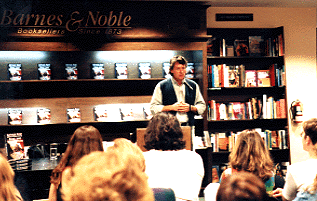 ...comes the second printing of the U.S. edition of RISK AND REDEMPTION.
Thanks to readers like you, RISK's sales are strong and demand is increasing; each day sees the book appearing on the shelves of more bookstores across the country.
So far, I've traveled to 11 states, spoken to classes at eight top universities and appeared at 28 in-store signings -- and we're not done yet.
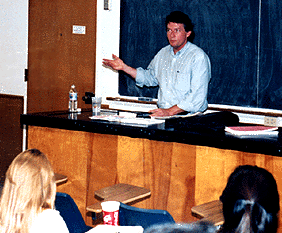 In November I'll be speaking to classes at the University of Michigan, Wayne State, the University of California at Berkeley, the University of Minnesota, the University of Wisconsin, Madison and George Washington University in the nation's capital. As well as bookstore signings along the way, there is the annual authors' night at the National Press Club Wednesday November 19 at 5:30 p.m., when the public is invited to meet a total of 75 authors and choose their favorite books for signing.
(Personally, as a reader and reporter, I can't wait for this one: Walter Cronkite, a pioneering hero to most of us in broadcasting, will be there signing the new paperback edition of his book.)
These events do much more than support sales of RISK AND REDEMPTION. They're also opportunities to shed more light on the central themes of the book: the decline in standards of American broadcast news and the hyper-commercialization of our major network news divisions.
It's the biggest open secret in the business: an excessive reliance on ratings has caused an abandonment of what really counts in journalism -- credibility. In a recent speech in New York, Ted Koppel of ABC's Nightline contrasted our dilemma to the dangers faced by journalists risking everything to pursue their craft under repressive regimes. "We celebrate their courage," Koppel said, "even as we exhibit increasingly little of our own. It is not death, or torture or imprisonment that threatens us as American journalists, it is the trivialization of our industry.
"We have the responsibility to do more: To focus on foreign events and to explain to the American public how and why those events have an impact on us." He concluded: "We react too much and anticipate too little. We struggle to be first with the obvious. The most important events of the last couple of years have not been the OJ Simpson trial and the death of Princess Diana."
There's the flashpoint, the glaring inconsistency between what we as journalists know to be true and what too many ratings-hungry programmers demand that we exploit. The show doctors, after all, believe that OJ and Diana are huge revenue spinners -- that considerations like perspective, balance and responsibility are obstacles to commercial success and should therefore be pushed aside. Our professional survival depends on our willingness to resist commercial strongarming. We've got to speak out for quality -- and soon.