
A MATTER OF BALANCE
Stopping by Washington again...
...I didn't want to miss the panel discussions at the Freedom Forum's Newseum to mark the 25th anniversary of Watergate, and how the scandal changed the public's perception of politics and the news media. In 1972, I was just starting university, so coverage of Watergate and the resulting debate over the power and responsibility of the press sharpened my appetite for a career as a reporter.
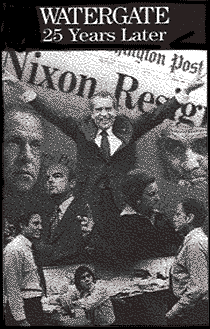
One big issue that grew out of the controversy: the notoriety gained by Bob Woodward and Carl Bernstein as they broke story after story revealing the extent of the break-in and dirty tricks campaign waged by the Nixon White House against the Democratic Party.
"Woodstein's" editor, Benjamin Bradlee, became nearly as famous as his two hard-charging newshounds, and in his panel exploring the higher profile all reporters took on after Watergate, he put everything into perspective -- at least for me -- when he said: "I got into this business to right wrongs. I believed that if you saw something wrong and you could help put it right with your reporting, then that was a wonderful thing to do."
The other seasoned panelists -- Jules Witcover of the Baltimore Sun, Jack Nelson of the L.A. Times, Eleanor Clift of Newsweek and Judy Woodruff of CNN -- all had a lot to say, but Bradlee's gruff, direct manner clearly swayed the audience. This was a journalist who had worked his way to the top and could charm -- or confront -- his management while juggling a newsroom full of unruly and ambitious reporters at the same time. And he has a disarming sense of humor. "At some point," he said, "it became all right for your daughter to marry a reporter. And I guess it's been all down hill ever since."
Though they disagreed on many points (Jules Witcover, for instance, argued with considerable effect that point/counter-point political debate programs such as the McLaughlin Group detract from the public's comprehension of U.S. politics), the panel gradually came around to confirming that there needs to be balance in a journalist's self-perception. Without being deathly serious, he or she mustn't become a showboat, a prima donna or a star eclipsing the whole object of the reporting exercise -- the story.
I left the Newseum encouraged that thoughtful discussion of our craft is still possible, even though hyper-commericalism -- printing or programming only the news that sells -- threatens too many quarters of the industry, especially in television news. The balance between business expediency and public responsibility has shifted dangerously. That's a wrong that needs to be set right, and if we, as journalists don't get on with that challenge by selecting and reporting our stories more faithfully, then who will ?