
AND THAT'S THE WAY IT IS...
It's an honor, no question about it...
|
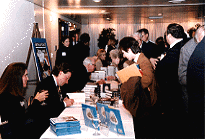
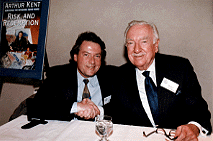
...to be invited to join 74 other authors signing copies of their work at the National Press Club's 20th Annual Book Fair in Washington D.C. But to learn from Julie Schoo, the Club's membership director, that Walter Cronkite has called ahead to ensure that this reporter will be seated at his side for the event -- well, it was a moment that made all the hard years on the trail of foreign news seem worthwhile. |
 |
 |
You see, Walter Cronkite and the reporting traditions he represents ignited the very first sparks of interest in my mind for broadcast news as a kid watching our family's 21-inch black-and-white Electrohome from the living room rug. His "20th Century" documentaries about World War Two prompted a stream of questions to my father, Parker Kent, also a reporter and newspaper columnist with broad experience overseas. It was Cronkite who took me into space with the Mercury, Gemini and Apollo astronauts; I was nine years old when he announced the tragedy of John F. Kennedy's assassination -- and the shock of Lee Harvey Oswald's murder the following day. |
I had the pleasure of meeting Mr. Cronkite and his wife Betsy on one previous occasion, a television festival held just a few weeks after the conclusion of the 1991 war in the Persian Gulf.
We had a long discussion, just he and Betsy, my mother Aileen and I, about the severe and unprecedented censorship regime enforced by the Pentagon and the Bush administration during that conflict.
In his memoir "A Reporter's Life", Cronkite explains his firm belief that denial of access to the battlefield undermines the very foundations of a free press.
Actually, his book reads a lot like a conversation with Walter Cronkite. The tempo is relaxed and the style is as reassuring as it is informative. As well, throughout "A Reporter's Life," there's a resonant quality of professionalism as the broadcaster for whom the term "anchor man" was originally coined explains what a lifetime in news is all about.
There's humour and irony: we very nearly had no Walter Cronkite; as a rookie in radio he was given the name 'Walter Wilcox' by the manager of KCMO Kansas City. "There was a conceit at radio stations then," he writes, "that their talent might skip to another station. To prevent them from taking their fame with them, the station 'owned' their name." Fortunately, Cronkite held onto his true byline in his lengthy and distinguished run at United Press, where he served during World War Two.
He recalls his service with "the Writing Sixty-ninth" gang of correspondents covering the air war over Nazi Germany. He worked alongside the legendary Homer Bigart of the New York Times, Bob Post of the same newspaper, and a guy named Andy Rooney -- then of Stars and Stripes. Covering an American raid on a German submarine base, they shared the immense risks taken by the aircrews: Bob Post's Liberator bomber was shot down and he was lost. Cronkite writes: "... the antiaircraft fire was intense. Golden bursts of explosives all around us, dissolving into those great puffs of black smoke. As the flyboys said: "So thick you could get out and walk on it."
The twists and turns of the narrative, however, never overwhelm the aspect of the book that is clearly Cronkite's priority, namely leaving the reader with some comprehension of the higher goals and meaning of American broadcast news. Particularly as he describes CBS News and its coverage of American politics and government, Cronkite and his colleagues appear to be equally concerned with the consequences of their newscasts, not just the viewership they acquire. Journalism counts for much, much more than simply sensational "grabber" stories sandwiched between commercials -- a value system that seems forgotten by too many of today's broadcast news elite and their conglomerate-appointed managements.
Of conditions these days he writes: "I don't envy those many serious broadcast journalists on both sides of the microphone who must work in this environment. The lack of respect in which they are held by their network managers is rubbed in their noses every day when the network-owned stations put the trashy syndicated tabloid 'news' shows on in the preferred evening hours once occupied by the genuine news programs."
He warns of the threats to free speech posed by the various kinds of dysfunction now plaguing America's news companies. One of his suggestions should ring like a rallying call to American journalists everywhere: "Big business must accept some public responsibility to, first, support government programs to improve education, and, second, support those quality newspapers and/or broadcast programs that genuinely strive to keep the people informed."
Cover to cover, "A Reporter's Life" left me encouraged and optimistic. And needless to say, Walter Cronkite's handwritten notation on the title page of my own copy has energized me for the battles ahead: "For Arthur Kent -- One of the best of our breed."
The achievements of Cronkite and his contemporaries, people like John Chancellor and David Brinkley, Eric Sevareid and so many others, constitute lifetime accomplishments in journalism that should point the way to a revival of the ethics and standards that once made America a world leader in broadcast news.
There is, in fact, a road back from the ratings-mad decline in quality suffered by too many of our news programs. And the signposts are there, easily picked out in places like the pages of Walter Cronkite's book.