
A QUEST FOR QUALITY
Sold out in Seattle...
...out of books, that is, at a well-attended signing in Barnes & Nobles' University Village location. Next morning, I was feeling good about much more than the increasing visibility of RISK AND REDEMPTION in the U.S. market. I was going home to Canada -- just up the Pacific coast north of Vancouver, British Columbia, to the 15th annual Sunshine Coast Festival of the Written Arts.

Each year the festival invites a group of Canada's leading writers to the town of Sechelt, a short ferry or float plane ride from Vancouver. At the lovely and historic Rockwood Lodge overlooking the waters of the inside passage between the mainland and Vancouver Island, crowds gather for readings, talks and book signings with their favorite writers. For this non-fiction scribe, it's both an honor to be asked to join the author's line up and a chance to learn from the experiences and accomplishments of dedicated literary professionals.
And what pro's. Among the twenty-two: George Bowering, a Governor General's Award winner for both fiction and poetry; internationally-known mystery writers Peter Robinson and John Brady; science fiction bestseller Spider Robinson; outstanding first novelist Anita Rau Badami; "White Dawn" author James Houston, one of Canada's great authorities on the Arctic and its inhabitants; singer/songwriter Rick Scott, Vancouver's wonderful "Philharmonic Fool"; and fellow journalist and friend Jan Wong, whose outstanding "Red China Blues" documents her life's journey from Mao's cadres to the ranks of North America's most distinguished reporters.
I follow Jan as the closer to the second day's readings. A spectacular Pacific sunset has given way to soft twilight as more than 500 people take their seats in the auditorium, one side open to the night. This remarkable space formed by giant timbers and rough-hewn logs has the scent of memory about it -- the West Coast forests have been one of my favorite hideaways since childhood. Now, the privilege of meeting face to face hundreds of readers who have helped make my first book a success at home and a contender in the coming autumn season south of the 49th parallel.
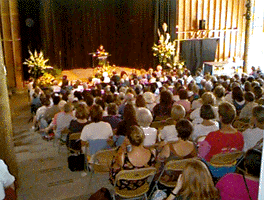
I find their questions to be challenging and at times worrying. As in the U.S., a lot of people harbor suspicion and mistrust towards the news media. The word "conspiracy" is mentioned. "Is there a conspiracy", I'm asked, "by the big media owners to distract the public's attention from their true corporate and political agenda with vapid or sensational program content ?" To me, conspiracy is both too strong and too complimentary a term. Too strong in that it encourages paranoia over some vast, dire master plan that does not, in this reporter's opinion, exist. Too complimentary in that I believe it's mainly a simple, venal quest for profit by too many big media companies that has sapped the strength and quality from broadcast news in North America.
Sure, companies like General Electric enjoy greater comfort having transformed subsidiaries such as NBC News into editorially tame profit providers. It's one less news agency to pose potential challenges to any future managerial misconduct. But the main objective, as with too many other big owners, is profit, profit and more profit -- forcing all news programs to compete with game shows, soaps, sit-coms and sports for the highest ratings possible, regardless of the imbalance dealt to the presentation of each day's events.
Still, my views aside, the doubts and suspicions linger within our communities. It's clear that the news media, particularly television, is losing credibility and gaining vocal opponents. Both my audience and this writer end our session together asking the same question: how do we turn things around ? I look to the other outstanding authors at the Sunshine Coast Festival for a clue. They've been encouraged by the attentions of their readers to keep turning out books, the very best books they can. It's called pride of authorship -- the knowledge that delivering quality literature will lead to success.
Broadcast journalists aren't all that different in that sense, are we ? What if more of us spoke out for quality, for covering the news for the sake of solid commercial journalism, rather than the practice of compromising quality for the sake of ratings. At this point, what have we, as professionals in a time of editorial decline, got to lose ?